What Is the Yoga Sutra?
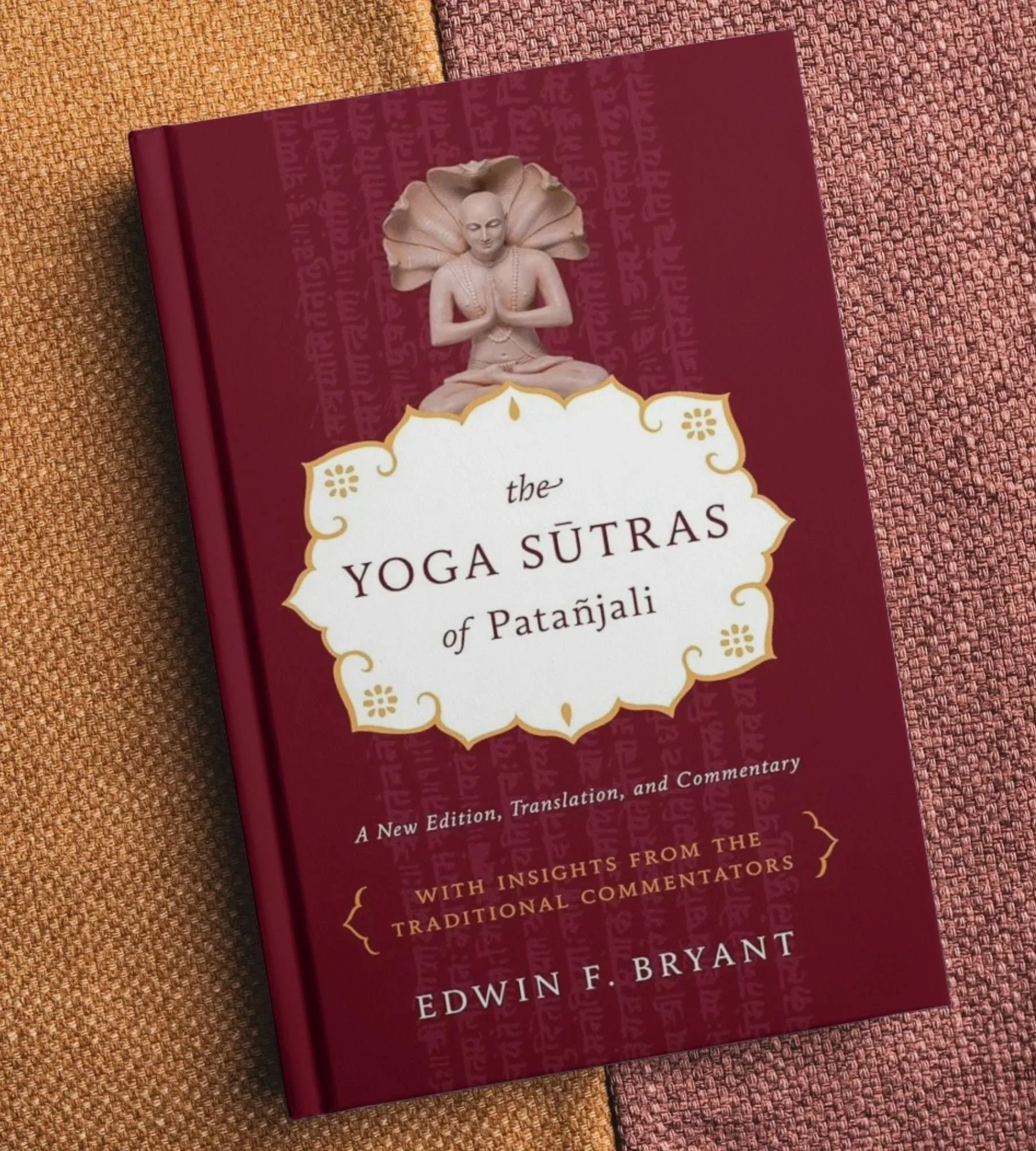
About 2,000 years ago, the story goes that Patanjali was instructed by his teacher to go out into the culture and observe what was being called “yoga.” What he found was likely a wide range of practices, philosophies, and interpretations. His task was not to invent something new, but to organize and clarify what already existed.
The result is what we now call the Yoga Sutras of Patanjali.
In many ways, the Yoga Sutra is a compilation — a distillation of essential teachings into a concise and structured form.
The text contains 195 short statements. Each one is called a sutra, a Sanskrit word meaning “thread.” These threads are woven together into four chapters, known as pada, meaning “foot” or “section.” The brevity of the sutras is intentional. They are compact by design, meant to be unpacked slowly and carefully, ideally with guidance.
The Yoga Sutra is not a manual of postures. In fact, only one posture is mentioned: the seated meditation position. There are no detailed sequences, no lists of poses, and no elaborate breath techniques laid out step by step.
Instead, the text offers something more fundamental.
It explains why the mind moves.
Why we become attached.
Why we suffer.
And how freedom is possible.
At its core, the Yoga Sutra is a study of attention. It is concerned with how to tend to the mind, how to stabilize awareness, and how to cultivate concentration through sustained practice. It describes a process of refinement — not of the body, but of perception itself.
Traditionally, the Sutra was studied with a teacher. The teacher would understand the individual student and prescribe specific practices — postures (asana), breath work (pranayama), and purification techniques (kriya) — according to that person’s needs. The text itself provides the philosophical map; the teacher provided the practical application.
One of the most well-known teachings from the Sutra is simple and direct: yoga is the stilling of the movements of the mind. When the mind becomes quiet, it reflects our true nature clearly, like a calm lake reflecting the moon. When the mind is restless, that reflection is distorted.
In this sense, yoga is not about becoming something new. It is about removing the agitation that prevents clear seeing.
When the mind is at rest, awareness is no longer caught in habitual patterns of attachment and aversion. The text describes this as freedom — a release from the karmic cycles that keep us bound to confusion and repetition.
The Yoga Sutra ultimately asks us to look closely at our own experience.
Have you ever noticed a moment when your mind was deeply still? Perhaps in nature, in meditation, or unexpectedly during an ordinary day? What was that experience like? What changed in your perception?
These moments, however brief, point toward what the Yoga Sutra is describing.
The invitation of this ancient text is not to believe something, but to observe carefully — and to discover, through practice, what becomes possible when attention stabilizes and the mind grows quiet.